CNS Geiger Counter Program
Bringing Nuclear Science Into the Classroom
The Canadian Nuclear Society’s Geiger Counter Program brings hands‑on radiation science directly into Canadian classrooms. By providing teachers with safe, easy‑to‑use instruments and ready‑made learning activities, the program helps students explore the natural radiation that surrounds us every day. Our goal is to replace fear and misconceptions with curiosity, evidence‑based understanding, and real scientific skills.
What Is a Geiger Counter?
A Geiger counter is a scientific instrument that detects ionizing radiation—the tiny energetic particles and waves that come from natural sources all around us. Radiation is part of everyday life. It comes from the ground, the air, the food we eat, and even from space. A Geiger counter like the one shown here helps students explore this invisible world by turning radiation into measurable data.

How Does It Work?
The CNS program uses the GQ GMC‑600 series, a classroom‑safe digital Geiger‑Müller detector.
Inside the device is a Geiger‑Müller tube, a small chamber filled with gas. When a particle of radiation enters the tube:
- It ionizes the gas (knocks electrons loose)
- The device detects the resulting electrical pulse
- The counter records it as a “click” or a count
The device displays these counts as:
- CPS (counts per second)
- CPM (counts per minute)
- Dose rate (µSv/h)
Students can watch the numbers change in real time or connect the device to a laptop to view live graphs.

Simple, Safe Classroom Experiments
All activities use naturally occurring, low‑level sources that are safe for classroom use. These experiments help students explore radiation scientifically and build data‑analysis skills.
1. Measure Background Radiation
What students do:
Turn on the Geiger counter and record CPM readings over time.
What they learn:
- Radiation is always present
- Levels vary naturally
- Data fluctuates statistically
Extension: Graph CPM over 10 minutes and discuss why the numbers change.
2. Compare Different Materials
Materials:
- Granite sample or rock
- Salt substitute containing potassium chloride (KCl)
- Ceramic mug (some glazes contain trace natural radioisotopes)
What students do:
Hold the Geiger counter near each object and record CPM.
What they learn:
Geology affects natural background levels
- Some everyday materials emit small amounts of natural radiation
- Some foods (e.g., bananas, iodized salt) contain naturally occurring radioactive material
- Geology affects natural background levels
3. Shielding Experiment
Materials:
- Paper
- Aluminum foil
- Plastic
- A small granite rock or KCl sample
What students do:
Place materials between the Geiger counter and the object.
What they learn:
- Different materials block radiation differently
- Alpha particles are easily stopped
- Beta and gamma behave differently
Extension: Predict which material will block the most radiation, then test.
4. Distance and Radiation Intensity
What students do:
Measure CPM at different distances from a naturally radioactive object.
What they learn:
- Radiation intensity decreases with distance
- Inverse‑square relationships in physics
- Measurement uncertainty increases at low count rates
5. Live Graphing on a Laptop
What students do:
Connect the Geiger counter to a laptop and watch real‑time graphs.
What they learn:
- How scientific instruments collect and visualize data
- How to interpret trends and fluctuations
- How shielding or distance changes the graph instantly
Why Students Love This Program
- It turns invisible science into something they can see and measure.
- It connects physics, chemistry, biology, and environmental science.
- It builds real data‑analysis skills using authentic scientific tools.
- It sparks curiosity about nuclear science, medicine, and energy.
Get Involved
The CNS is committed to making radiation science accessible to classrooms across Canada. Schools, teachers, and supporters can help expand the program’s reach and impact.
Interested in participating or supporting the program? Contact us to learn more.
IAEA APPs for Chart of the Nucldies
The International Atomic Energy Agency has developed Chart of the Nuclides APPS that are available for free on the iPhone / iPad APP store and the Android phone / tablet APP store. We have confirmed that the Android APP will work on Chromebooks. Testing has shown that if the Chromebook display is set to “small,” such as 1518 x 853 (instead of the native 1366 x 768 for the Asus device used) the “Element” display is easily used by moving the window — 2 fingers on the touch pad. We’re working on videos for these.
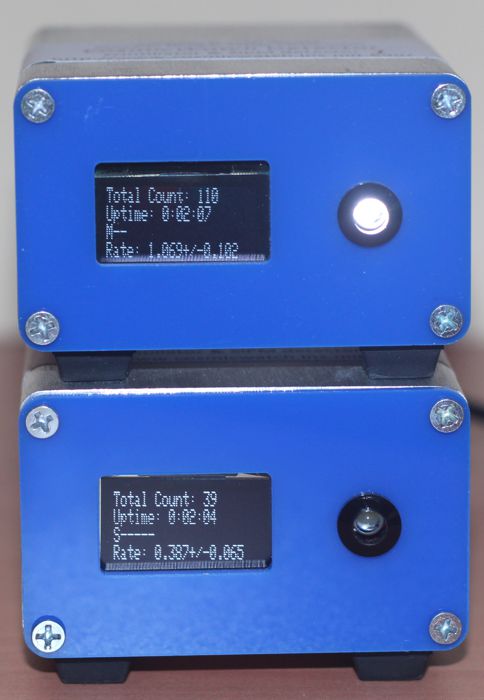
These scintillator-based detectors may be stacked vertically with one of them slaved to the “master” to detect coincident events. The majority of the coincident events result from muons generated by cosmic rays interacting with the earth’s atmosphere. The white led flashes when a detection event occurs. The displays show that the slave (lower unit) detected 39 counting events “coincident” with the master (upper unit) detecting 110 counts in the same nominal interval. The sensitivity of the 2 detectors has been adjusted (a software parameter) to provide comparable count values with the instruments side by side and not master/slaved.
Aware Electronics interface cable connector problem
CAUTION FOR USB-MSP INTERFACE USERS! Please leave your USB cable connected to the interface. One interface was retuned to the CNS with the mini USB connector extracted from the interface and stuck on the mating cable connector. The damaged interface is not repairable.
Potassium Chloride Salt 40K Sources

The CNS Geiger Kits first included NoSalt®. The Windsor Salt Company sells Salt Free / Sans Sel® — an alternative to the more expensive NoSalt® at less than $5 in most grocery stores in Canada. About $1.20 per kBq of 40K! (It may be a special order item in some stores.) Both suppliers also have a “Half Salt” product, — a mix of NaCl and KCl.
The CNS Nu-Salt … (K-40) Fact Sheet has been updated — see below!
Ionisation Radiation Workshop Videos
Check out the CNS IRW YouTube Channel
An article on NORM (reproduced with permission), by B. White of the CNS ECC, was published in STAO’s “Crucible” prior to the 2008 Workshop presentation.
An article entitled “Henri Bequerel, Winner of the 1903 Nobel Prize in Physics: A Change of Hypothesis“ published in Crucible in 2013 is reproduced with permission.
Another article on the Hot Balloon Experiment (reproduced with permission), was published in Crucible prior to the 2011 Workshop presentation at STAO.
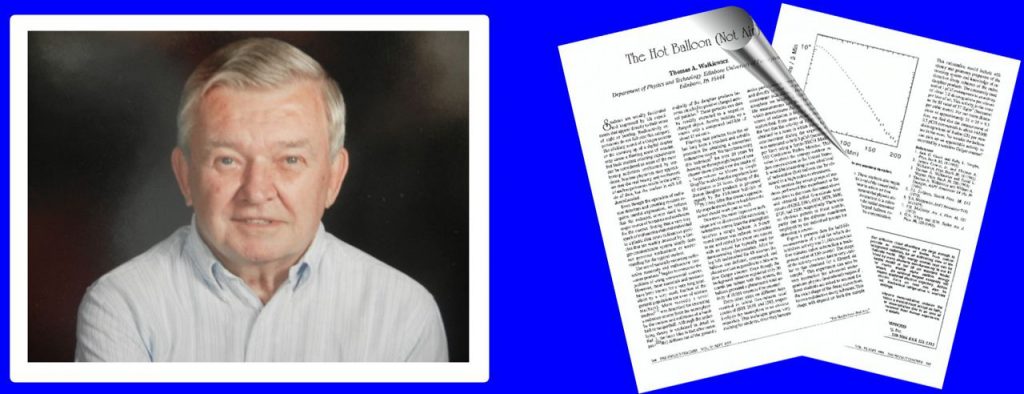
A PDF version of Thomas A. Walkiewicz 1995 paper: “The Hot Balloon (Not Air)” is posted with the permission of The Physics Teacher (American Association of Physics Teachers).
Online Resources re Ionising Radiation
The Jefferson Laboratory has a series of videos on the measurement of the half-life of barium-137 as the Frostbite Theater: Part 1, Part 2, Part 2e, Part 3. Students may collect and analyse the data from the videos.
Tasha Richardson has a website featuring remote access interactive labs for science students (presented a workshop at STAO 2017).
The CNS ionising radiation workshop references the brochures below.
CNS Educational Brochures
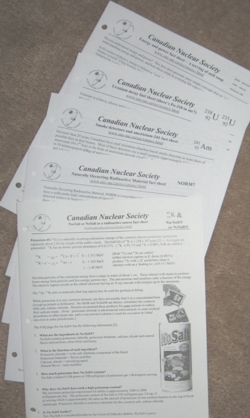
The following CNS educational brochures are available for download:
- Nu-Salt, NoSalt or Salt Free as a radioactive source (2018 February)
- Uranium decay fact sheet (there’s Po-210 in me?) (2018 February)
- Smoke Detectors and Americium-241 (2010 October)
- Compact Fluorescent Lamps – Radioactive or Not? (2011 January )
- Energy and power fact sheet – a serving of unit soup (2010 April)
- Americium-241 vs. Plutonium-239 (2010 April)
Please check back here for the most recent version of these files and new ones.
The French language fact sheets are availalble for download:
- Feuillet éducatif sur succédanés de sel comme source radioactive(2016 octobre)
- Feuillet éducatif sur les substances radioactives naturelles (2010 avril)
- Feuillet éducatif sur la désintégration de l’uranium (du Po-210 en moi ?) (2014 juillet)
- Feuillet éducatif sur les détecteurs de fumée et l’américium-241 (2011 mars)
- Feuillet éducatif sur les ampoules fluorescentes compactes — radioactives, ou pas? (2011 février)
- Feuillet éducatif sur l’énergie et la puissance – et pot-pourri d’unités (2010 avril)
- Feuillet éducatif sur l’américium-241 et le plutonium-239 (2010 avril)
This informative summary of radiation dose information is now hard to find on the internet:
- An enlarged version of USA DOE Office of Science Low-Level Radiation Dose Ranges chart.
Comments or suggestions are most welcome!
CNS Geiger Kit Donations
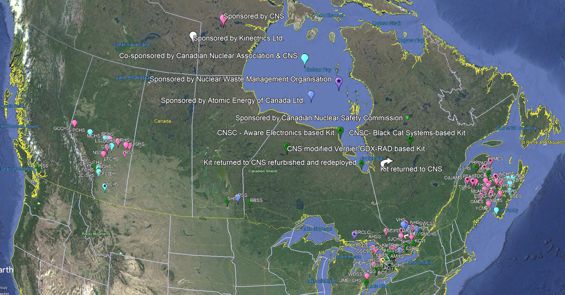
Google Earth Map image (not up to date)
Live Google Map (not up to date)
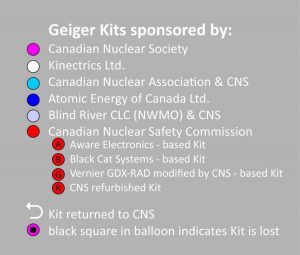
With the support of our sponsors, the CNS has donated Geiger kits to 272 science teachers at Canadian high schools from St John’s NL to Victoria BC as shown in the Google Earth® image & searchable map above (7 of these are considered to be lost). 6 have been returned from schools, refurbished and placed with new schools. Most of the high schools do not reply to our “annual” email polls. We suspect that many of the early CNS Geiger Kits that were limited to use with Windows XP® and Vista® are no longer being used as the computer interface used at that time is not compatible with most more modern computers.
If you requested a CNS Geiger Kit and have not received one it may be due to our having old contact information. Please contact the CNS ECC with an updated request.